

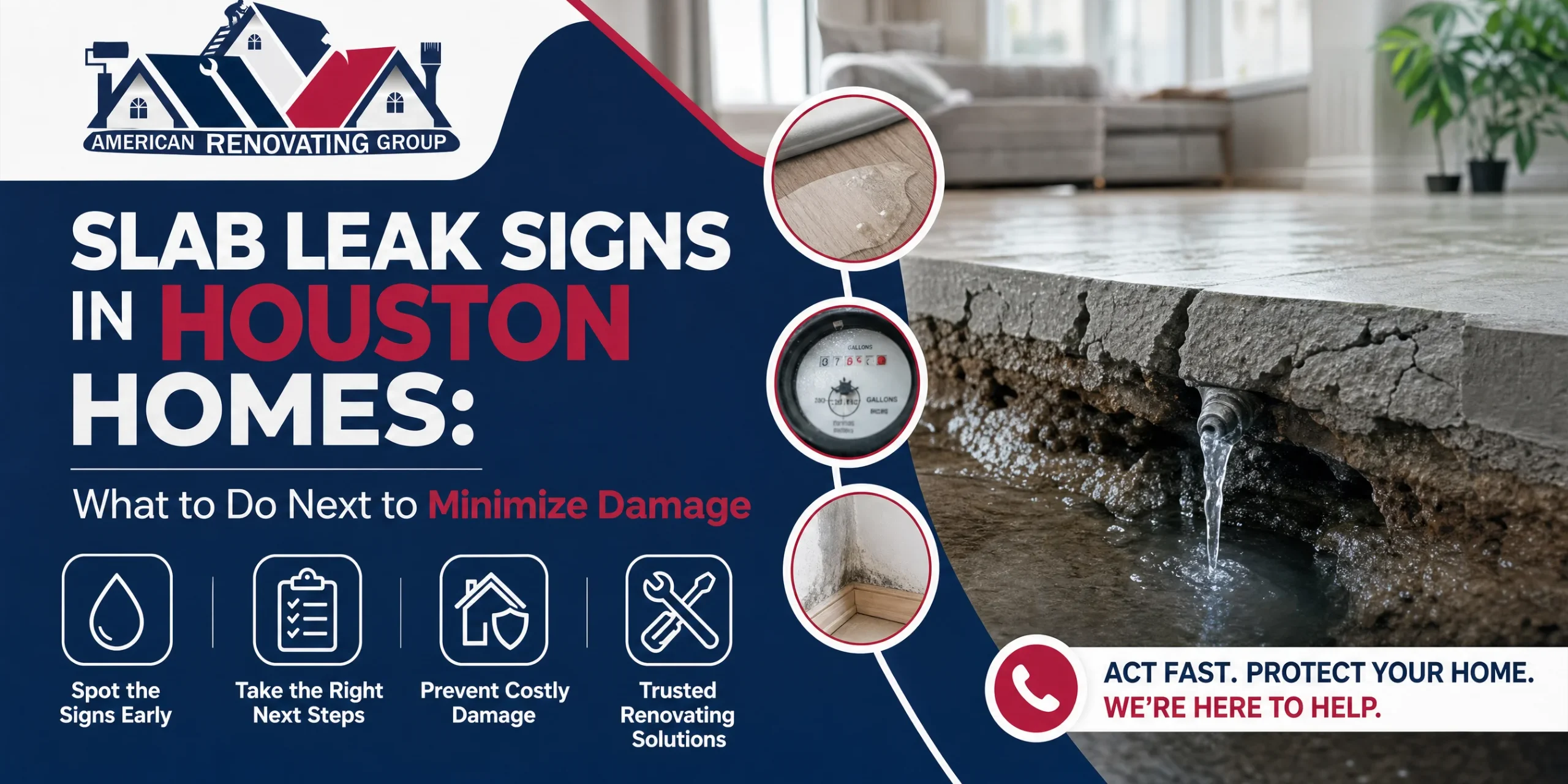
Slab Leak Houston: Early Signs, Fast Checks, and Repair Options
Slab Leak Houston: Early Signs and What to Do Next to Minimize Damage
A slab leak is a pressurized water line leak that develops under a home’s concrete foundation. In Greater Houston—where many homes are slab-on-grade—these leaks often reveal themselves as damp flooring, unexplained warm patches, or a sudden jump in your water bill. Acting quickly but calmly helps protect flooring and finishes, limit moisture damage, and reduce the risk of foundation movement.
Fast checks you can do right now
- Turn off all fixtures and watch the water meter for movement.
- Feel for warm or damp spots on tile or concrete floors.
- Listen for running water sounds with fixtures off.
- Compare last month’s bill and note any big, unexplained increase.
- Inspect baseboards for swelling, staining, or a mildew odor.
- If water is surfacing indoors, shut off the main water valve.
[Image alt text: Technician using thermal imaging for slab leak Houston detection]
Why Slab Leaks Happen More Often in Houston
- Slab-on-grade foundations are common across Greater Houston, so plumbing typically runs under concrete.
- Expansive clay soils and seasonal moisture changes can stress pipes, especially at joints.
- Older neighborhoods may have mixed pipe materials and legacy repairs that age differently than newer systems.
These realities don’t guarantee a water leak under slab, but they make early detection and the right repair plan especially important in our area.
Common Slab Leak Signs in Houston Homes
High Water Bill Without a Clear Reason
If your normal usage hasn’t changed but your bill suddenly spikes, you may be dealing with a water leak under slab. Rule out the obvious first—irrigation timers, dripping faucets, or a running toilet—(see EPA tips for finding household leaks) then consider a professional slab leak assessment if the numbers still don’t add up.
Damp Floors, Warm Spots, or Mildew Odor
- Damp or “sweating” areas that don’t match spills or pet activity
- Persistent warm patches on tile or concrete (often a hot-water line leak)
- Musty or earthy smells near baseboards or in slab-level closets
Running Water Sounds When Fixtures Are Off
Hearing a faint hiss or trickle in a quiet room with all taps off is a red flag. Confirm that your water heater isn’t refilling due to an unrelated issue, then arrange for leak detection if the sound persists.
Low Water Pressure or Hot Water Running Out Fast
Unexplained pressure drops or hot water that depletes faster than usual can occur if a supply line is leaking under the slab and constantly feeding water into the ground.
Cracks in Flooring or Foundation Movement Indicators
Tile or wood buckling, grout cracking in a pattern, or new hairline cracks in concrete may signal prolonged moisture or slight movement. Not every crack means a slab leak, but combined with a high bill or damp floors, it warrants an investigation.
Water Meter Moving When No Water Is Used
Shut off all fixtures and appliances, confirm irrigation is off, and check the meter:
- If the dial or small triangle indicator spins, water is moving somewhere.
- If you have a house-side shutoff, close it and re-check the meter. If the meter stops, the issue is inside the home; if it keeps moving, it’s likely between the meter and the house.
Immediate Steps to Minimize Damage (Before a Pro Arrives)
How to Safely Shut Off Water (Main Valve Basics)
- At the curb: Many Houston homes have a municipal meter box near the street. Use the homeowner-side shutoff if present. If not, the meter may require a special key. Avoid forcing anything that could damage city equipment.
- At the house: Look for a ball valve near the water heater, garage wall, or exterior hose bib. Turn the handle a quarter-turn clockwise to stop water flow.
Tip: If you’re unsure, call a local pro. We can talk you through the basics of shutting off water over the phone.
Power and Appliance Safety Around Wet Areas
- Keep cords, electronics, and small appliances off damp floors.
- If water reaches outlets, baseboards, or the water heater, avoid touching switches and consider shutting off power at the breaker for affected rooms.
- Never step into standing water that could contact electrical sources.
Documenting Damage for Insurance (Photos, Dates, Meter Readings)
- Take photos and short videos of damp areas, baseboards, flooring changes, and the meter if it’s moving.
- Note dates, times, and any meter readings.
- Save receipts for fans or dehumidifiers. Good documentation helps when speaking with your insurer.
Simple Moisture Control: Towels, Fans, and Fresh Air
- Blot standing water with towels and rotate them often.
- Use fans to move air. If outdoor humidity is low, briefly open windows to ventilate.
- Avoid high heat; steady airflow and dehumidification work better than trying to “bake” moisture out.
When to Avoid DIY (Concrete, Pressurized Lines, and Risk Notes)
- Don’t break concrete to “look around.” It’s easy to miss the source and create more damage.
- Avoid pressurized line repairs without proper tools and materials. Temporary patches often fail and worsen damage.
- Skip harsh chemicals marketed to seal leaks—these can harm piping or clog lines.
How Pros Confirm a Water Leak Under Slab
Non-Invasive Leak Detection Methods (Acoustic Listening, Thermal Imaging)
- Acoustic listening: Specialized equipment detects the sound signatures of pressurized leaks beneath concrete.
- Thermal imaging: Infrared cameras reveal heat patterns from hot-water leaks and cooling effects from moisture.
These non-invasive tools help narrow the target to the smallest possible area before any floor is opened.
Line Tracing and Isolation Testing
Technicians trace probable supply-line routes and perform isolation testing (such as capping or zone pressure tests) to determine which line is leaking. This step informs the best approach—spot repair or rerouting—before any concrete is removed.
When Exploratory Access Is Needed
When the suspected location is confidently pinpointed, a small, controlled opening in the slab may be created to expose the pipe and verify the exact issue. Careful saw-cutting, dust control, and floor protection keep disruption to a minimum.
Slab Leak Repair Options in Houston
Direct Spot Repair (Pros/Considerations)
- Pros: Addresses the specific failure point with a smaller footprint when the leak is localized.
- Considerations: Ideal when piping is otherwise in good condition and accessible; typically requires opening a small section of slab and flooring.
Rerouting/Bypass Lines (Pros/Considerations)
- Pros: Abandons the failed under-slab segment and runs a new line through walls, attic, or ceilings to avoid future slab access.
- Considerations: Involves a bit more finish work, but often faster and less invasive than extensive slab demo—especially for repeat leaks or older piping.
Epoxy Lining in Certain Cases (When It’s Considered)
Internal coatings are sometimes evaluated for specific pipe materials and layouts, particularly when access is difficult and the network is a suitable candidate. Suitability depends on pipe type, age, and configuration; not every home is a match.
Coordinating Repairs: Plumbing, Drying, and Finish Restoration
The strongest outcomes come from treating plumbing repair, moisture control, and finish restoration as a single plan:
- Plumbing repair Houston: Confirm the source, choose spot repair or reroute, and verify success with pressure testing.
- Structural drying: Use air movers and, when needed, dehumidifiers to return materials to acceptable moisture levels and help prevent mold.
- Finish restoration: Patch concrete, reinstall or repair flooring and baseboards, and repaint walls/trim where necessary.
American Renovating Services Group coordinates each step to reduce downtime and confusion—one contact for leak detection, repair, drying, and restoration. To see the breadth of our work beyond emergency plumbing, explore our trusted Houston renovation team for full-service renovations and maintenance in apartments and homes (https://americanrenovating.com/).
What to Expect: Timeline, Access, and Cleanup
Houston technician investigates damp flooring and foundation lines after a spike in the water bill.
Typical Visit Flow: Inspection → Detection → Estimate → Repair
- Initial call and safety guidance: We’ll help you locate a shutoff and stabilize the affected area.
- On-site detection: Acoustic listening, thermal imaging, and isolation testing.
- Findings and options: Clear explanation of repair paths and a written estimate.
- Repair and verification: Complete the agreed repair, pressure test, and confirm no further movement at the meter.
- Drying and restoration plan: Set up drying if needed and schedule finish work.
Noise, Dust, and Access Considerations in Occupied Homes
- Expect some noise from saw-cutting or coring if slab access is required. We use dust control, plastic containment, and floor protection.
- We’ll plan access routes ahead of time to protect furnishings and limit movement through living spaces.
- Pets should be safely secured away from work zones.
Post-Repair Testing, Dry-Out, and Floor/Finish Repairs
- Verification: We confirm meter stability and system pressure.
- Drying: Depending on moisture levels, fans and/or dehumidifiers may run 24–72 hours or more.
- Restoration: The concrete patch cures, then flooring and paint are repaired or replaced. For broader planning and finish ideas, see our Essential Home Renovation Tips (https://americanrenovating.com/renovation-tips/) and Home Renovation Project Management strategies (https://americanrenovating.com/home-renovation-project-management-strategies-for-a-successful-remodel/). If you’re considering upgrades during restoration, explore Energy-Efficient Home Upgrades (https://americanrenovating.com/energy-efficient-home-upgrades-eco-friendly-remodeling-savings/).
Choosing a Trusted Team for Plumbing Repair Houston
Licensing, Insurance, and Experience with Slab Leaks
Ask for proper licensing and proof of insurance. Experience matters—especially with slab leaks across both newer subdivisions and older Houston neighborhoods with varied piping materials.
24/7 Availability, Communication, and Local Response
Slab leaks don’t wait for business hours. Our team is available for 24/7 inquiries at +1 (346) 666-7705. Clear, steady communication—before, during, and after the repair—keeps surprises to a minimum and helps you plan around normal life.
Coordinated Services: Leak Detection, Repairs, and Restoration
Working with a single Houston-based partner streamlines the process:
- Leak detection and diagnosis
- Repair (spot repair or reroute) with verification testing
- Structural drying and cleaning
- Finish restoration: flooring, painting, and touch-ups
To see the breadth of our work beyond emergency plumbing, explore our trusted Houston renovation team (https://americanrenovating.com/) for full-service renovations and maintenance in apartments and homes.
Real Job Insight from Our Houston Team
On a recent Houston project, a homeowner reported a warm tile path in the kitchen and a bill spike. Our crew used acoustic listening to narrow the hot-water line leak to within about a foot. That accuracy let us open a small section of the slab, complete the repair, and coordinate drying and floor patching the same day—keeping disruption low and the living area usable.
Myth vs. Fact: Slab Leaks
- Myth: “If the floor is dry today, it’s not urgent.”
Fact: Slab leaks can run intermittently or into the soil, causing hidden erosion and ongoing moisture. Early assessment limits damage. - Myth: “I can just pour in a sealer and be done.”
Fact: Chemical quick-fixes can damage piping and rarely address the source. Professional leak detection avoids guesswork. - Myth: “Repair always means tearing up half the house.”
Fact: Many repairs use small, targeted access or rerouting that avoids widespread demolition.
Who We Help in Greater Houston
We serve homeowners throughout Greater Houston, from newer slab-on-grade communities to established neighborhoods inside the Loop and beyond. If you manage rental homes or small multifamily properties, we can coordinate occupied repairs with clear scheduling and communication. For broader planning in active residences, see Apartment Renovation Houston: What Property Managers Should Expect (https://americanrenovating.com/apartment-renovation-houston-process-expectations/).
Coordinated Restoration and Next-Step Planning
When a slab leak affects finishes, we can bundle plumbing repair with:
- Drying and moisture checks
- Flooring repairs or replacement
- Baseboards, trim, and repainting
- Post-cleaning to leave the space tidy
If you’d like to turn restoration into an opportunity, we can help you plan Energy-Efficient Home Upgrades (https://americanrenovating.com/energy-efficient-home-upgrades-eco-friendly-remodeling-savings/) and provide Renovation Planning advice (https://americanrenovating.com/renovation-tips/).
Your Calm Path Forward: Slab Leak Houston Help
If you suspect a slab leak Houston situation:
- Shut off water if it’s surfacing indoors or the meter is spinning.
- Move items away from damp areas and document with photos.
- Call a trusted local team for leak detection and plumbing repair Houston guidance.
American Renovating Services Group offers coordinated leak detection, repair, drying, and finish restoration across Greater Houston. For 24/7 inquiries and same-day assessments when available, call +1 (346) 666-7705. We’ll help you confirm the source, choose the right fix, and restore your home with as little disruption as possible.
Frequently Asked Questions
What is a slab leak, and why is it common in Houston?
Short answer: A slab leak is a pressurized water line leak under your concrete foundation, and it’s common in Houston because many homes are slab-on-grade with plumbing running beneath concrete and soils that stress pipes.
Expanded: A slab leak occurs when a supply line under the slab develops a failure—often at joints or due to pipe movement. In Greater Houston, slab-on-grade construction is widespread, plumbing is routed under concrete, and expansive clay soils plus seasonal moisture shifts can stress piping. Older neighborhoods may also mix pipe materials and legacy repairs, increasing the chance of a water leak under slab over time.
What are the early signs of a slab leak Houston homeowners should watch for?
Short answer: Unexplained high water bill, damp floors or warm spots, musty odors, running-water sounds, pressure drops, and meter movement with fixtures off.
Expanded: If usage hasn’t changed but your bill spikes, check for damp or “sweating” areas on floors, persistent warm patches (often hot-water line leaks), musty smells near baseboards, or faint trickling with all taps off. Low pressure and hot water running out faster than normal can also indicate a leak. Confirm by turning off all fixtures and watching your water meter—if it moves, water is flowing somewhere unexpectedly.
How can I check for a water leak under slab right now?
Short answer: Turn off fixtures, verify irrigation is off, and watch the meter. If it moves, you likely have a leak; if you close your house-side shutoff and it stops, the issue is inside.
Expanded: Do these quick checks: shut off all fixtures and appliances, then check the meter’s main dial or triangle indicator. If it spins, water is moving. If you have a house-side shutoff, close it and re-check—if movement stops, the problem is within the home; if not, it may be between the meter and the house. Feel for warm or damp floor areas and listen for hissing/trickling in a quiet room.
Should I shut off water if I suspect a slab leak Houston situation?
Short answer: Yes—especially if water is surfacing indoors or the meter is spinning. Use your main shutoff and call a pro.
Expanded: If you see moisture indoors, shut off the main valve to limit damage. Many Houston homes have a municipal meter box near the curb; use the homeowner-side shutoff if present. You may also find a house shutoff by the water heater, garage, or hose bib. If you’re unsure, call us and we’ll talk you through it over the phone before we arrive.
Can I DIY a slab leak repair?
Short answer: No. Avoid breaking concrete or patching pressurized lines—temporary fixes often fail and can cause more damage.
Expanded: Concrete demo without precise location often misses the source and expands the repair area. Pressurized line repairs need proper tools and materials; quick-fix chemicals can harm pipes. Focus on safe shutoff, moisture control, and documentation, then schedule professional leak detection and plumbing repair Houston service.
How do pros find a water leak under slab without tearing up floors?
Short answer: Non-invasive tools like acoustic listening and thermal imaging narrow the target before any floor is opened.
Expanded: Technicians use acoustic equipment to hear leak signatures and thermal cameras to spot heat or cooling patterns. They may trace lines and perform isolation or zone pressure tests to confirm the exact line. Only after high-confidence pinpointing do they create a small, controlled access point, keeping dust and disruption low.
What are my repair options—spot repair vs. reroute (and when is epoxy considered)?
Short answer: Spot repairs fix a localized failure; rerouting abandons the under-slab segment to prevent future slab access; epoxy is evaluated case-by-case.
Expanded: Direct spot repair is ideal when piping is otherwise sound and accessible with a small opening. Rerouting/bypass runs a new line through walls, attic, or ceilings—often faster and less invasive for older systems or repeat failures. Epoxy lining is considered only in specific pipe types and layouts; not every home is a candidate. Your leak detection results guide the best path.
How long does detection and repair take, and what mess should I expect?
Short answer: Many jobs include same-day detection and targeted repair, with some noise and dust control if slab access is needed; drying and restoration follow.
Expanded: The typical flow is inspection → detection → estimate → repair. If cutting is required, expect some noise; we use plastic containment, dust control, and floor protection. Drying equipment may run 24–72 hours or more, then we handle concrete patching and finish restoration. For broader planning ideas, see Essential Home Renovation Tips and Project Management strategies on our site.
Will insurance cover a slab leak and related repairs?
Short answer: It depends on your policy. Document everything and contact your insurer promptly.
Expanded: Coverage varies by carrier and policy details. Take dated photos/videos of damp areas and meter movement, note readings, and keep receipts for fans/dehumidifiers. Your insurer will advise what’s covered (e.g., access, plumbing repair, drying, and finishes). We can provide documentation of findings and repair steps to support your claim.
How do I control moisture and reduce mold risk after a slab leak?
Short answer: Blot water, use steady airflow and dehumidification, and avoid high heat; then complete structural drying and finish restoration.
Expanded: Towel up standing water, run fans to move air, and add dehumidifiers as needed. If outside humidity is low, brief ventilation helps. After the plumbing repair, professional drying returns materials to acceptable moisture levels before flooring and paint repairs begin. We coordinate drying and restoration to help prevent secondary damage.
Who should I call for coordinated plumbing repair Houston services and restoration?
Short answer: American Renovating Services Group handles leak detection, plumbing repair, drying, and finish restoration in Greater Houston. Call 24/7 at +1 (346) 666-7705.
Expanded: We streamline the process with one point of contact—from pinpointing a water leak under slab to pressure testing, structural drying, and restoring flooring, baseboards, and paint. Explore our full-service Houston renovation team at https://americanrenovating.com/ for apartments and homes.
From real jobs: what does a typical slab leak Houston repair look like on the ground?
Short answer: We often locate the leak to within a foot using acoustic/thermal tools, open a small slab area, repair, test, and start drying the same day.
Expanded: Recently, a Houston homeowner noticed a warm tile path and a bill spike. Our crew confirmed a hot-water line leak using acoustic listening, opened a small section of slab, completed the repair, pressure-tested, and set drying equipment—keeping the living area usable and minimizing disruption.
American Renovating Services Group offers coordinated leak detection, repair, drying, and finish restoration across Greater Houston. For 24/7 inquiries and same-day assessments when available, call +1 (346) 666-7705. We’ll help you confirm the source, choose the right fix, and restore your home with as little disruption as possible.