

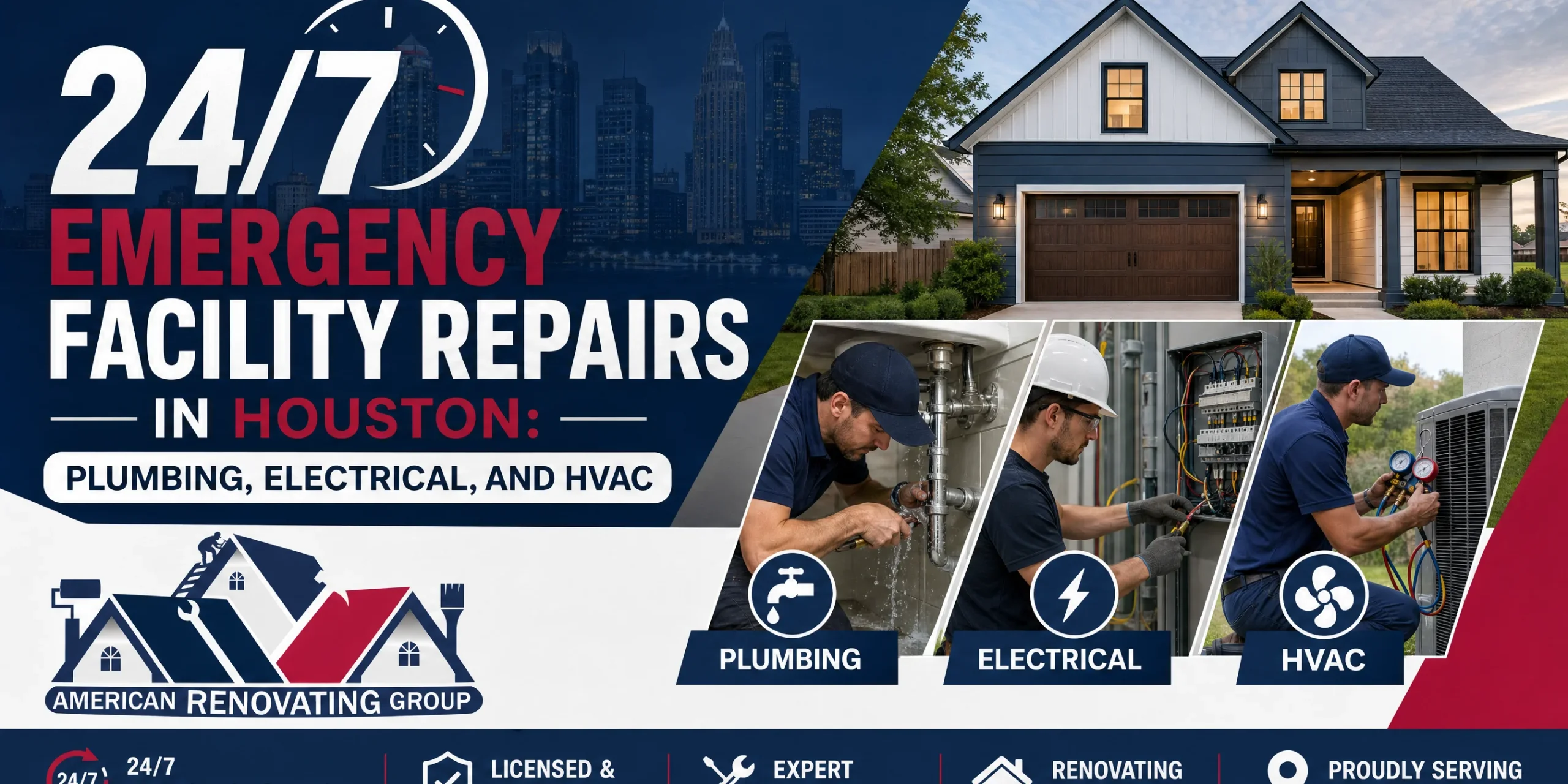
24/7 Emergency Facility Repairs Houston: Plumbing, Electrical, and HVAC
When a critical building system fails, minutes matter. American Renovating Services Group delivers 24/7 emergency facility repairs Houston property teams can count on—single‑call, multi‑trade response for plumbing, electrical, and HVAC issues across apartments, multifamily, commercial offices, retail, and light industrial spaces. From the first phone call, expect rapid response, safety‑first stabilization, and clear next steps. For immediate dispatch, call +1 (346) 666-7705 any time, day or night.
24/7 emergency facility repairs Houston refers to immediate, around‑the‑clock response for critical plumbing, electrical, and HVAC failures in Houston buildings—prioritizing safe stabilization, rapid diagnostics, and urgent repairs to protect people and property.
- If it’s safe and you have access, shut off water or power.
- For plumbing: active leaks, burst pipes, or sewer backups.
- For electrical: sparking, burning odors, partial/total power loss, exposed wiring.
- For HVAC: no cooling/heat in critical areas, server rooms, or health‑sensitive spaces; smoke or unusual smells from air handlers.
- Keep people away from hazards; ventilate only if safe; document with photos.
- Call +1 (346) 666-7705 for dispatch and provide building access details.
When to Call for 24/7 Emergency Facility Repairs in Houston
Houston’s climate and building mix—from mid‑rise multifamily and garden‑style apartments to medical suites and server rooms—means small problems can escalate quickly. If you’re uncertain whether to call, err on the side of safety and reach out.
What qualifies as an emergency vs. urgent but non‑emergency
Emergency (call now):
- Active water leaks or burst pipes that you cannot stop at a fixture
- Sewer backups or flooding affecting habitability or egress routes
- Electrical sparking, burning odors, smoked panels, exposed conductors
- Widespread power loss to critical areas (egress lighting, elevators, fire/life safety interfaces, refrigeration)
- No cooling or heat in critical zones (server rooms, healthcare/elder‑care units, infant care, food storage)
- Gas odors (after calling your utility/gas provider and 911 as needed)
- HVAC units smoking, tripping breakers repeatedly, or alarming
Urgent but typically non‑emergency (same/next‑day scheduling):
- Slow leaks you have isolated at a fixture shutoff
- Intermittent breaker trips with no odor or visible damage
- Comfort cooling or heating loss in non‑critical areas with operable windows or temporary solutions available
If there’s any doubt about safety, treat it as an emergency.
Safety‑first checklist before we arrive (shutoffs, lockouts, occupant safety)
- Water: If accessible and safe, close the affected fixture valve; if the leak persists, locate the nearest branch or main shutoff. Avoid standing water near any electrical equipment.
- Power: If you smell burning or see arcing, keep people clear and shut off the affected breaker only if you can do so safely. Do not open panels if you see visible damage or smoke.
- HVAC: Turn off smoking or banging units at their disconnect or breaker. For critical zones, move sensitive equipment or people to safe, conditioned areas if possible.
- Lockout/Tagout: If your facility has LOTO procedures, initiate them for the affected equipment to prevent accidental re‑energizing.
- Occupant Safety: Keep hallways clear, set up cones/wet floor signs, and ventilate areas with odors if it can be done safely.
- Documentation: Snap photos and note times, odors, alarms, and any steps taken. This speeds diagnosis and helps with follow‑up records.
- Access: Arrange keys/fobs, gate codes, and an on‑site contact for rapid entry—more on this below.
Rapid Multi‑Trade Response: Plumbing, Electrical, and HVAC
Our after‑hours maintenance model removes the 2 a.m. vendor juggling. One call dispatches the right trade—or a coordinated team—so you get stabilization first and a seamless handoff to corrective work, without wasting time.
Emergency Plumbing
Common emergencies:
- Burst domestic lines, chilled‑water leaks, and sprinkler‑related water release (post‑all‑clear)
- Main riser or branch leaks saturating walls/ceilings
- Sewer backups into units, corridors, or restrooms
- Fixture failures and supply hose blowouts
Typical first moves on arrival:
- Swiftly isolate the leak using local or floor valves
- Contain water with barriers, wet‑vacs, and managed drain pathing
- Protect adjacent units with plastic sheeting and door sweeps
- Begin moisture mapping for targeted dry‑out and mold prevention
We’ll coordinate wet‑vac, dehumidification, and realistic timelines for repairs and restoration, then, if needed, line up follow‑up wall/ceiling repairs through our renovations team—so you’re not left piecing together vendors.
Emergency Electrician Houston
What we handle:
- Partial or total power loss to critical areas
- Repeated breaker trips, overheated conductors, or hot/burning odors
- Water‑impacted panels or outlets after a leak event
- Damage from storms, surges, or failed components
On‑site electrical triage:
- Confirm a safe approach and initiate lockout/tagout as required
- Inspect affected panels, feeders, and branch circuits without energizing unsafe equipment
- Isolate the faulted path, restore safe power where possible, and document findings
- If water intrusion is suspected, coordinate safe dry‑out procedures and re‑inspection before re‑energizing
Our goal is to prevent escalation and get essential lighting, life‑safety interfaces, and critical loads protected or restored safely.
Emergency HVAC Repair
Typical issues:
- No cooling/heat in critical or high‑occupancy zones
- Server room AC failures and high‑temp alarms
- Packaged unit failures during heat advisories or hard‑freeze conditions
- Unusual odors, smoke, or electrical trips from air handlers or condensers
Stabilization steps:
- Shut down unsafe units; inspect disconnects, contactors, capacitors, and safeties
- Deploy temporary cooling/heating solutions where appropriate
- Check condensate management to prevent secondary water damage
- Verify airflow and life‑safety interlocks before re‑start
- Provide a plan for repair or replacement parts with clear timelines
What to Expect from Our After‑Hours Maintenance Process
We keep the process predictable so your team can act decisively while help is on the way. From call intake to follow‑up, communication stays clear and practical.
Call intake, dispatch, and ETA considerations in Greater Houston
- Call +1 (346) 666-7705 and share the issue, address, access details, and on‑site contact.
- We assign the appropriate trade(s) and confirm your priority level based on risk to life, safety, and property.
- We provide an ETA informed by traffic, weather, and time of day. Night shifts often shorten drive time across Beltway 8 and the Loop, though major storms and flooding can affect routes. We’ll keep you updated along the way.
On‑site triage: stabilize, diagnose, communicate the plan
First hour on site:
- Secure the scene and prevent escalation (water shutoffs, lockout/tagout, equipment isolation, barriers)
- Assess immediate hazards and communicate any temporary closures or detours
- Diagnose the root cause to the extent safely possible
- Provide a clear, verbal action plan for the next 2–24 hours, including any parts or specialty support needed
Follow‑up restoration and documentation for property records
- Written summary of findings, photos (if permitted), and recommended corrective work
- Coordination for restoration tasks—dry‑out, electrical re‑inspection, fixture replacement, finish repairs
- Transparent estimates for corrective work and a proposed schedule you can share with stakeholders and residents
- Post‑incident coordination with your team on communication and access
For broader context on renovations and post‑incident work, see our Houston renovating services for apartments and homes: https://americanrenovating.com/
Property Manager Guide: Quick Actions That Help Minimize Damage
In an emergency, small, safe steps make a big difference. The more prepared your team is, the faster we can stabilize and start recovery.
Location of main shutoffs and panels
- Keep an up‑to‑date map of water mains, floor valves, and key fixture shutoffs (toilets, washers, ice machines).
- Maintain a labeled electrical panel directory—ensure emergency lighting and life‑safety circuits are clearly marked.
- Know where HVAC disconnects are located and verify access is clear of storage or obstructions.
Photos, incident notes, and tenant communication
- Capture photos or short videos of the issue and the affected area, including ceiling/wall moisture and breaker status.
- Time‑stamp key moments: discovery, shutoff attempts, alarms, odors.
- Notify tenants of safety measures, expected noise, and entry needs. For tips on coordinating with residents during work, explore our guide on https://americanrenovating.com/optimizing-renovation-communication-and-workflow-for-occupied-multifamily-apartment-communities/
Access instructions and keys/fobs for faster entry
- Provide gate codes, elevator permissions, and any special parking notes (loading dock, height limits).
- Have keys/fobs ready or authorize on‑site security/concierge to release them.
- If a unit is affected, secure pet information and occupant contact to avoid delays.
These steps help us move from “arrival” to “stabilized” without losing precious minutes.
Compliance, Safety, and Quality You Can Trust
Licensed trades and code‑compliant work
Your emergency shouldn’t create a second problem down the line. We dispatch trained technicians for plumbing, electrical, and HVAC, and complete work in alignment with applicable codes and manufacturer requirements. We follow lockout/tagout, confined space, and ladder safety practices as the situation demands, and coordinate with local utilities and AHJs when needed.
Clear estimates for corrective work
After stabilization and diagnosis, you’ll receive straightforward recommendations and written estimates for corrective repairs or replacements. We’ll outline options, timelines, and any dependencies so you can make an informed decision without surprises.
Real‑World Experience: Night‑Shift Stabilization Done Right

Rapid, around-the-clock plumbing, electrical, and HVAC help for Houston facilities from American Renovating Services Group.
On our Houston night rotation, we responded to a chilled‑water leak that flooded a corridor at 1 a.m. Our lead tech isolated the nearest valve, protected adjacent units with barriers, and coordinated wet‑vacs and dehumidifiers before sunrise to prevent secondary damage. It’s a common scenario here, and the key is fast isolation plus targeted dry‑out—so a leak doesn’t turn into a days‑long disruption.
Myth vs. Fact: After‑Hours Maintenance
- Myth: “If the breaker keeps tripping, just reset it until morning.”
- Fact: Repeated trips can signal a dangerous fault or overheating conductor. Keep people clear and call an emergency electrician Houston property teams can trust to diagnose safely.
- Myth: “A small ceiling drip can wait.”
- Fact: Even slow leaks can spread across fire‑rated assemblies and into electrical systems. If you can’t isolate it at a fixture, treat it as an emergency to limit structural and IAQ risks.
- Myth: “Server rooms can ride out the night without cooling.”
- Fact: High temperatures can lead to equipment failure and data loss. Temporary cooling and immediate HVAC evaluation are critical.
Service Area: Greater Houston, 24/7 Availability
We serve the Greater Houston area—inside the Loop, Galleria, Energy Corridor, Midtown, Medical Center, Uptown, Westchase, Greenspoint, Pasadena, Pearland, Sugar Land, Katy, Spring, and more. From garden‑style apartments and high‑rise corridors to office suites, retail bays, and light industrial spaces, our dispatch model adapts to local traffic and weather patterns to deliver the fastest safe response.
- Property types we support:
- Apartments and multifamily communities
- Commercial offices and mixed‑use
- Retail and restaurants
- Light industrial and flex spaces
For property managers planning next steps after stabilization, these resources may help:
- Planning and budgeting for follow‑up repairs: master renovation planning and budgeting
- Post‑stabilization efficiency upgrades: energy‑efficient home upgrades: https://americanrenovating.com/energy-efficient-home-upgrades-eco-friendly-remodeling-savings/
- Apartment operations continuity: faster apartment turns: https://americanrenovating.com/apartment-turns-houston-faster-unit-turns/ and make ready services: https://americanrenovating.com/make-ready-services-apartment-turns-guide/
How We Keep Houston Buildings Running—Calmly and Safely
Our approach is built for Houston realities:
- Heavy rain and humidity: We prioritize water isolation and moisture mitigation to protect finishes and indoor air quality.
- Hard‑freeze events: We respond to burst lines, failed heat, and freeze‑related electrical issues with focused triage and clear repair options.
- Storm‑related surges: We stabilize electrical systems, verify grounding and bonding where relevant, and coordinate safe re‑energizing.
- Traffic and access: We set realistic ETAs and keep you updated, coordinating dock/garage entry to minimize delays.
Behind the scenes, our team documents the incident so your property records stay organized—useful for insurance, capital planning, and resident communication. If a larger restoration is needed, our renovations group can transition from emergency to repair without hand‑offs getting lost between vendors. For a broader look at renovation planning beyond emergencies, visit our Houston renovating services hub: https://americanrenovating.com/
Frequently Asked Questions
What counts as a true emergency vs. urgent but non-emergency?
Short answer: Emergencies are active hazards that threaten people or property right now; urgent items can usually wait for same/next-day service.
Expanded answer: Call immediately for active leaks or burst pipes, sewer backups, electrical sparking/burning odors, widespread power loss to critical areas, gas odors (after contacting your utility/911), or HVAC loss in critical zones like server rooms or healthcare/elder-care units. Items like slow, isolated leaks or comfort cooling loss in non-critical areas are typically urgent but not after-hours emergencies.
What should I do before your team arrives?
Short answer: If it’s safe, shut off water or power, keep people clear, document the issue, and set up fast access.
Expanded answer: Close fixture or branch shutoffs for leaks, shut the affected breaker if safe, power down smoking/banging HVAC units, keep occupants away from hazards, and take photos. Arrange keys/fobs, gate codes, and an on-site contact so we can enter quickly.
Do you provide one-call, multi-trade help after hours?
Short answer: Yes—one call dispatches plumbing, electrical, and HVAC support as needed.
Expanded answer: Our 24/7 emergency facility repairs Houston model eliminates late-night vendor juggling. We send the right trade—or a coordinated team—to stabilize first, then hand off to corrective repairs without losing time.
How fast can you get to my property in Greater Houston?
Short answer: We give a realistic ETA based on risk, traffic, weather, and time of day.
Expanded answer: Call +1 (346) 666-7705. We prioritize life safety and property risk, then provide an ETA. Night traffic can shorten drive times, but storms and flooding may affect routes. We keep you updated until arrival.
What if a breaker keeps tripping or I smell something burning?
Short answer: Keep people clear, don’t keep resetting, and call now.
Expanded answer: Repeated trips and burning odors can indicate dangerous faults. If safe, shut the affected breaker and call for an emergency electrician Houston property teams can trust. Do not open damaged panels or re-energize wet equipment.
What about HVAC failures in server rooms or critical areas?
Short answer: Treat it as an emergency.
Expanded answer: High temperatures can damage equipment and data. We’ll stabilize the situation, inspect safely, and deploy temporary cooling or heating if appropriate, then outline repair steps and timelines for emergency HVAC repair.
Do you help with water mitigation after a plumbing emergency?
Short answer: Yes—stabilize, isolate, then dry-out.
Expanded answer: We isolate leaks, contain water, start moisture mapping, and coordinate wet-vacs and dehumidification to prevent secondary damage. If needed, our renovations team can handle follow-up wall/ceiling repairs so nothing falls through the cracks.
What areas and property types do you serve?
Short answer: Greater Houston, 24/7, including apartments, offices, retail, and light industrial.
Expanded answer: We cover areas inside the Loop, Galleria, Energy Corridor, Medical Center, Uptown, Westchase, Greenspoint, Pasadena, Pearland, Sugar Land, Katy, Spring, and more. Property types include multifamily, commercial offices, retail/restaurants, and light industrial/flex spaces.
How does the after-hours process work?
Short answer: Call, dispatch, stabilize, diagnose, then plan repairs.
Expanded answer: We collect issue details and access info, confirm priority, and provide an ETA. On arrival, we secure the scene, diagnose safely, and deliver a clear plan for the next 2–24 hours. You’ll receive written findings, photos (if permitted), and estimates for corrective work.
How can I speed up response and minimize damage?
Short answer: Know your shutoffs, prepare clear access, and document early.
Expanded answer: Keep maps of main and branch shutoffs, label electrical panels, and ensure HVAC disconnects are accessible. Provide gate codes, elevator permissions, parking notes, and unit access (pets/contacts). Photos and time-stamped notes help us diagnose faster. For resident coordination tips, see: https://americanrenovating.com/optimizing-renovation-communication-and-workflow-for-occupied-multifamily-apartment-communities/
Real-world example: What does a typical night emergency look like?
Short answer: Fast isolation, targeted dry-out, and a clear plan before morning.
Expanded answer: On a recent overnight call, we isolated a chilled-water leak, protected adjacent units with barriers, and started dehumidification before sunrise. The key steps—quick shutoff, safe electrical practices, and focused moisture control—kept the corridor usable and prevented a longer disruption.
How do I start service right now?
Short answer: Call +1 (346) 666-7705, 24/7.
Expanded answer: For 24/7 emergency facility repairs Houston teams rely on, call any time. Share your building name, address, issue summary, and access instructions. We’ll confirm priority, give an ETA, and dispatch the right trade(s) to stabilize and plan corrective work.
Your Next Step: Call Now for 24/7 Emergency Facility Repairs in Houston
If you’re dealing with an active leak, loss of critical power, or failed cooling/heating in a sensitive area, call +1 (346) 666-7705. You’ll reach a calm, professional dispatcher who will gather the essentials, confirm your priority, and send the right help. Prefer to initiate by form? Share your building name, address, issue summary, and access instructions—we’ll call right back to confirm dispatch.
When you need after‑hours maintenance across plumbing, electrical, and HVAC, one call to American Renovating Services Group means rapid response, safety‑first stabilization, and a clear, documented plan forward. For 24/7 emergency facility repairs Houston teams trust, we’re here—day or night.