
Parking Lot Striping Houston: ADA Requirements and Best Practices
Parking Lot Striping Houston: ADA-Compliant Markings and Maintenance Best Practices
Parking lot striping in Houston is more than paint on pavement—it’s about safety, accessibility, and reducing liability. When your markings meet ADA requirements, tenants and customers can move with confidence, risk drops, and daily operations feel smoother. This guide covers ADA essentials, commercial striping standards, and a maintenance approach tailored to Houston’s weather so you can stay compliant and avoid premature repaints. American Renovating Services Group is your local partner in Houston, available 24/7 at +1 (346) 666-7705. For broader renovation support across apartments and homes, visit our Houston overview: Houston renovating services for apartments and homes.
What “parking lot striping Houston” means in practice
In practical terms, parking lot striping Houston involves planning and applying pavement markings—stalls, access aisles, symbols, arrows, and safety zones—that meet ADA requirements and local standards. Done well, it improves accessibility, directs traffic cleanly, and enhances property safety while lowering compliance risk.
ADA Striping Requirements: What Houston Properties Need to Know
Accessible Stalls and Access Aisles
- Required accessible spaces: The number of accessible stalls scales with lot size. As counts rise, the number of required van-accessible spaces increases as well. In mixed-use or shared parking that serves multiple buildings, verify totals per facility rather than the entire site.
- Stall width and access aisles: Standard accessible stalls typically pair with a 5-foot access aisle; van-accessible spaces include either an 8-foot access aisle or a wider stall with a 5-foot aisle. Aisles must be clearly striped, level, and connect to the accessible route.
- Van-accessible considerations: Most lots require at least one van-accessible space, with more added as the accessible count grows. Mark these clearly and position them near the most direct accessible entrance.
- Location and slope: Place accessible stalls on the shortest accessible route to accessible entrances. Surfaces should be stable, firm, and slip-resistant, with slopes within allowable limits so water doesn’t pool in aisles and along routes.
Signage, Symbols, and Visibility
- International Symbol of Accessibility: Mark required spaces with the ISA symbol on the pavement and pair it with permanent signage. Avoid faded or undersized symbols—legibility matters.
- Van signage: Van-accessible spaces must include signage indicating “Van Accessible.”
- Mounting height basics: Signs should remain visible when vehicles are parked—mounted high enough to stay unobstructed and easy to see from a vehicle.
- Contrast and reflectivity: Use high-contrast colors and reflective beads or coatings where needed so markings remain visible in low light and rain.
Routes, Ramps, and Loading Zones
- Accessible route continuity: Provide a continuous, unobstructed path from accessible parking to entrances. Crosswalk markings help guide pedestrians across drive aisles.
- Curb ramp awareness: Curb ramps should not sit within access aisles. Protect and mark routes so vehicles don’t block ramp access.
- Passenger loading zones: If you provide passenger loading zones, ensure the width, access aisle, and connecting route are compliant and clearly delineated.
ADA Compliance Checklist (Quick Reference)
For reference, review the official ADA parking requirements.
- Count and location: Correct number of accessible and van-accessible spaces on the shortest accessible route to entrances.
- Dimensions: Accessible stalls and access aisles at compliant widths; aisles striped and marked “No Parking.”
- Signage: ISA and “Van Accessible” signs installed, visible, and mounted at proper height.
- Visibility: High-contrast pavement markings; symbols and stall lines readable day and night.
- Routes: Marked crosswalks to entrances; curb ramps positioned outside aisles; no tripping hazards.
- Condition: Markings intact—not peeling or faded; signs not bent, blocked, or missing.
- Drainage/slope: Accessible areas properly graded; no water pooling in aisles or along routes.
Commercial Striping Standards That Improve Property Safety
Traffic Flow, Arrows, and Fire Lanes
- Directional arrows and lane designations: Use clear arrows to prevent wrong-way driving and confusion in tight Houston lots—especially at retail centers and medical offices with frequent turnover.
- Ingress/egress clarity: Mark stop bars and yield points at driveways and internal intersections to reduce collisions.
- Emergency access awareness: Identify and maintain fire lanes and keep them unobstructed. Pair curb stenciling with “No Parking—Fire Lane” markings where required.
Wheel Stops, Speed Bumps, and Crosswalks
- Wheel stop placement: Install wheel stops consistently to protect landscaping, pedestrian paths, and building facades. Stripe or paint wheel stops for daytime and dusk visibility.
- Speed control: Mark speed bumps/humps clearly with high-contrast paint and advance warning symbols—especially helpful in apartment communities with children and pets.
- Crosswalk visibility: Use bold, high-contrast patterns at building entrances, mail kiosks, and pedestrian cut-throughs. Consider reflective elements near night-shift facilities or 24-hour operations.
Color, Contrast, and Night Visibility
- Paint selection: Choose traffic-grade coatings that deliver sharp, readable contrast on asphalt or concrete.
- Reflective media: Glass beads or reflective additives improve low-light visibility when Houston’s evening storms roll through.
- Consistent palette: Maintain consistent color standards across the site so drivers and pedestrians instantly recognize stall types, no-parking zones, and safety areas.
Pavement Markings That Last in Houston’s Climate
Materials: Paint vs. Thermoplastic vs. Epoxy
- Traffic paint: Economical, fast to apply, and great for routine re-striping. A smart option for properties with frequent layout changes or lighter traffic.
- Thermoplastic: Highly durable and reflective; ideal for high-wear drive lanes, crosswalks, and arrows. Requires proper surface prep and application within temperature windows.
- Epoxy or MMA systems: Strong adhesion and durability on concrete or heavy-use areas. Often chosen for loading zones, entrances, and locations exposed to oils.
- Fit-for-purpose approach: Many Houston properties blend materials—thermoplastic at critical control points and high-quality traffic paint for routine stalls—to balance performance and cost.
Surface Prep and Dry-Time Windows in Humidity
- Cleaning and prep: Sweep, blow, and pressure-rinse as needed. Remove dust, sand, and loose aggregate. Treat oil spots so coatings bond and don’t bleed through.
- Dry, bond-ready surface: After Houston showers, trapped moisture can cause peeling. Confirm surface dryness before layout and application.
- Humidity-aware scheduling: Plan work during favorable temperature and dew point windows. In summer, early mornings or evenings often hit the best cure times; in cooler months, plan around shorter daylight and longer dry times.
Layout Accuracy and Re-Striping Frequency
- Precision layout: Use chalk lines, measuring wheels, and templates to keep stall widths and symbol placement consistent.
- Traffic and sun exposure: High-traffic lanes, entrances, and south- or west-facing areas fade faster due to heat and UV. Expect more frequent touch-ups here.
- Lifecycle planning: Instead of full-lot repaints every time, schedule targeted refreshes in high-wear zones and a comprehensive re-stripe on a multi-year cycle based on material and usage.
Maintenance Best Practices to Reduce Repaints
Seasonal Inspections and Touch-Ups
- Spring check: Look for winter wear, storm debris abrasion, and fading. Refresh crosswalks and symbols before summer traffic peaks.
- Fall check: Prep for wetter months; address peeling edges and re-apply beads for night visibility ahead of earlier nightfall.
- High-traffic spot refreshes: Keep arrows, stop bars, and accessible symbols crisp year-round; these areas are most critical for safety and compliance.
Drainage, Debris Control, and Oil Stain Treatment
- Drainage: Clear inlets and gutters so water doesn’t sit on markings. Standing water accelerates wear and hides lines.
- Debris: Regular sweeping prevents grit from scouring paint and improves visual clarity.
- Oil and chemicals: Treat stains with approved cleaners and primers before they undermine adhesion or obscure ADA symbols.
Budgeting and Scheduling With Minimal Disruption
- Off-peak phasing: For apartments, coordinate building-by-building during typical work hours when lots are emptier. For retail and medical, schedule night or early-morning windows.
- Clear communication: Post notices and place cones early; map temporary parking to keep tenants and customers moving. If you manage apartments, see our renovation communication and workflow playbook for occupied communities for tips on smooth coordination: https://americanrenovating.com/the-ultimate-renovation-communication-and-workflow-playbook-for-occupied-apartment-communities/
- Consolidated services: Bundle re-striping with minor concrete/curb repairs, sign replacements, and power washing to minimize mobilizations and stretch your budget.
Myth vs. Fact: ADA and Commercial Striping
- Myth: “If the symbol is on the ground, I don’t need a sign.” Fact: Permanent signage is required for accessible and van-accessible spaces so they remain enforceable and visible when cars are parked.
- Myth: “I can place curb ramps in the access aisle.” Fact: Access aisles must remain level and clear; ramps should be adjacent but not inside the aisle.
- Myth: “All materials last the same—just buy the thickest paint.” Fact: Durability depends on material type, surface prep, and conditions. Thermoplastic, epoxy, and premium paints each have different performance profiles.
- Myth: “Once marked, we’re compliant for years.” Fact: Faded or damaged markings can create compliance gaps. Plan seasonal inspections and touch-ups to stay ahead of citations and risk.
Real-World Insight From the Field
On recent Houston multifamily projects, we’ve found the fastest way to avoid layout errors is snapping chalk lines the evening prior, then doing a quick walk with management at dawn before paint hits the pavement. In our humidity, that head start helps us catch small tweaks and still hit the best curing window before traffic returns.
How American Renovating Services Group Helps Houston Properties Stay Compliant
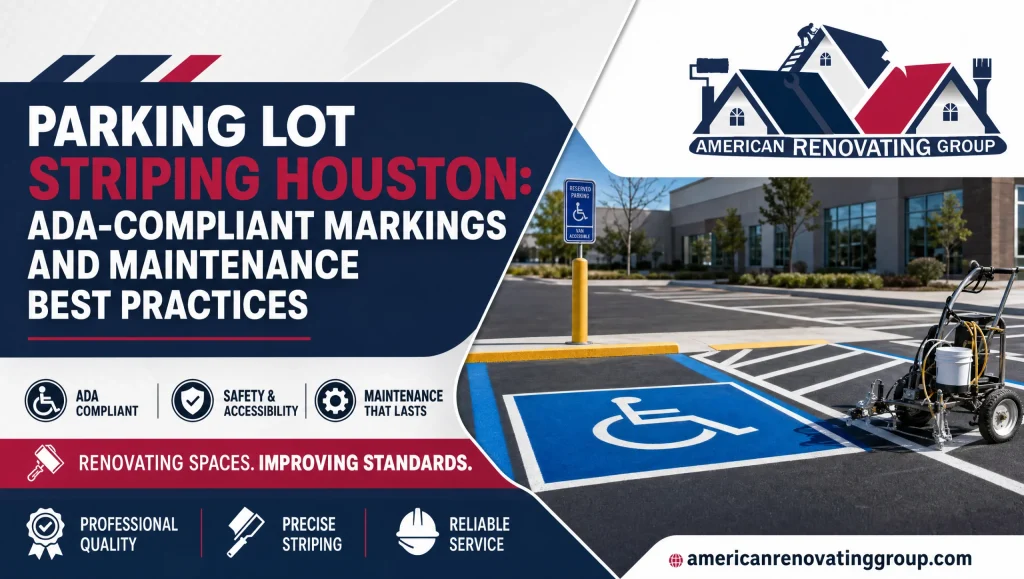
Houston commercial lot with ADA-compliant parking spaces, access aisles, and crisp pavement markings for safer access and flow.
Site Assessment, Layout Plan, and Clear Markups
- Walkthrough and count verification: We verify required accessible and van-accessible counts for your lot size and use.
- Layout optimization: We fine-tune stall widths, aisles, arrows, and crosswalks to improve traffic flow and property safety.
- Markups and phasing plan: You’ll receive a clear site markup and a practical schedule for phased areas to keep operations moving.
ADA-Focused Execution and Quality Checks
- Surface prep and materials: We prep for proper adhesion and select materials that match your traffic, budget, and Houston’s climate.
- Precise application: We measure twice and stripe once—placing symbols, text, and lines for readability and compliance.
- Final verification: We confirm counts, signage, visibility, and route continuity before turnover, documenting the layout for your records.
Ongoing Maintenance Plans and 24/7 Communication
- Scheduled inspections: Seasonal reviews with targeted touch-ups where visibility fades first.
- Rapid response: 24/7 availability for inquiries at +1 (346) 666-7705 to address safety-critical issues like faded crosswalks or missing signs.
- Proactive budgeting: We help plan annual spend and align work with off-peak windows for apartments, retail, and offices.
Planning striping during other property work
If you’re coordinating larger projects, our Houston apartment and home renovations team can align schedules so striping, signage, and related work happen during the same traffic-control window. See our apartment community renovation and maintenance guidance for broader operations planning: https://americanrenovating.com/comprehensive-guide-to-apartment-community-renovation-and-maintenance-projects-boost-resident-satisfaction-and-efficiency/. For faster turns, explore our make ready services to organize short maintenance windows with minimal disruption: https://americanrenovating.com/make-ready-services-apartment-turns-guide/. To keep residents informed during active work, see our occupied apartment renovations strategy: https://americanrenovating.com/occupied-apartment-renovations-strategy/ and our renovation communication and workflow playbook: https://americanrenovating.com/the-ultimate-renovation-communication-and-workflow-playbook-for-occupied-apartment-communities/. For a property manager’s perspective on coordinating upgrades around daily operations, you may also find this helpful: https://americanrenovating.com/apartment-renovation-houston-process-expectations/.
Practical Material and Scheduling Tips for Houston
- Blend materials by zone: Consider thermoplastic in drive aisles and crosswalks, and traffic paint in standard stalls to balance upfront and lifecycle costs.
- Time the weather: In warm, humid months, stripe in early morning or evening to reduce tack times and avoid afternoon storms. In cooler seasons, watch dew points and extend curing windows.
- Document everything: Keep a layout plan, material specs, and date-stamped photos. Documentation supports risk management, future refreshes, and vendor consistency.
Common Causes of Premature Failure (and How to Avoid Them)
- Moisture trapped under coatings: Confirm dry pavement after rain or overnight dew; moisture causes peeling and reduced reflectivity.
- Poor oil stain treatment: Without degreasers and primers, fresh paint lifts quickly.
- Skipping surface prep: Dirt, sand, and chalk residue reduce adhesion—do a final blow-off pass before applying.
- Over-application in one pass: Thick, single-pass applications can skin over, trap solvents, and wear unevenly. Two thin coats often outperform one thick coat.
- Traffic too soon: Respect cure times. Use clear barricading and signage so the first vehicles don’t smear markings.
Operations Notes for Different Property Types
- Multifamily communities: Stripe in phases (building clusters or zones) and map overflow parking ahead of time. Night work can reduce disruption, but ensure adequate lighting for quality control and safety.
- Retail centers: Coordinate with anchor tenants to schedule work after peak hours; stripe loading areas and accessible routes first so morning deliveries and early customers have clear guidance.
- Medical and professional offices: Prioritize ADA access and patient drop-off zones; use high-contrast crosswalks and reflective beads for pre-dawn and dusk appointments.
Image suggestion (alt text): parking lot striping Houston with ADA-compliant markings at an apartment community entrance
How This Ties Into Your Larger Property Plan
Parking lot striping is one part of a broader maintenance and renovation program. If you’re planning capital projects or upgrades, it can be smart to pair striping with exterior painting, minor concrete repairs, or lighting improvements. For a bigger-picture perspective on planning, budgeting, and team coordination, see our Houston apartment and home renovations overview: https://americanrenovating.com/ and our primer on what property managers should expect during apartment renovation in Houston: https://americanrenovating.com/apartment-renovation-houston-process-expectations/.
How American Renovating Services Group Keeps It Straightforward
- We speak compliance simply: You’ll know your counts, dimensions, signage, and routes are right.
- We design for real life: Clear traffic flow and readable markings reduce fender-benders and confusion.
- We maintain proactively: Seasonal checks, documented layouts, and quick touch-ups keep you ahead of fading—and citations.
Conclusion: Safer, Clearer Properties With Parking Lot Striping Houston
ADA-compliant parking lot striping Houston helps protect people, reduce liability, and keep traffic moving. With the right materials, precise layout, and a Houston-aware maintenance plan—seasonal inspections, drainage and debris control, and targeted refreshes—you’ll extend the life of your markings and stay compliant year-round. If you’re ready for a clear plan, responsive scheduling, and dependable results, contact American Renovating Services Group at +1 (346) 666-7705. We’re local to Houston, we understand the weather and property types here, and we’re available 24/7 to help you keep your site safe, compliant, and easy to navigate.
Frequently Asked Questions
What does ADA-compliant parking lot striping in Houston require?
Short answer: Correct counts and locations for accessible and van spaces, compliant stall and aisle dimensions, visible ISA symbols and signage, and a safe, continuous accessible route.
Expanded answer: ADA striping requirements in Houston include the right number of accessible and van-accessible stalls based on lot size, proper stall widths with clearly striped access aisles, the International Symbol of Accessibility on pavement plus permanent signs (including “Van Accessible” where required), compliant sign mounting heights, high-contrast markings, and an unobstructed accessible route with crosswalks and correctly placed curb ramps.
How many accessible and van-accessible parking spaces do I need?
Short answer: It depends on lot size and use; most sites need at least one van-accessible space, with more required as counts grow.
Expanded answer: The required number scales with the total stall count and the facilities served. Mixed-use properties may need to verify counts per building or facility. During our site assessment, we confirm accessible and van-accessible counts and their locations on the shortest accessible routes to entrances.
What materials work best for parking lot striping Houston projects: paint, thermoplastic, or epoxy?
Short answer: Use a fit-for-purpose mix—traffic paint for stalls, thermoplastic for high-wear areas, and epoxy/MMA for heavy-use or oil-prone zones.
Expanded answer: Traffic paint is economical and fast for routine re-striping. Thermoplastic offers excellent durability and reflectivity for drive lanes, arrows, and crosswalks. Epoxy or MMA systems bond well to concrete and high-traffic or oil-exposed areas like loading zones. Many Houston properties blend materials to balance cost and longevity.
How often should I re-stripe my parking lot in Houston?
Short answer: Inspect seasonally and refresh high-wear zones as needed; schedule full-lot re-striping on a multi-year cycle based on use and materials.
Expanded answer: Sun, UV, and heavy traffic fade markings fastest at entrances, drive lanes, and south/west exposures. Keep arrows, stop bars, and accessible symbols crisp year-round, and plan targeted touch-ups between full repaints. Documentation (layout plans, material specs, photos) helps time refreshes efficiently.
How do Houston humidity and rain affect striping schedules and dry times?
Short answer: Work in dry windows and cooler parts of the day; confirm surfaces are fully dry before coating.
Expanded answer: Moisture trapped under coatings causes peeling. In warm, humid months, early morning or evening typically offers better cure conditions and avoids pop-up storms. In cooler seasons, watch dew points, allow longer cure times, and verify bond-ready surfaces after showers.
What causes pavement markings to fail early, and how can I prevent it?
Short answer: Moisture, oil contamination, poor prep, over-application, and opening to traffic too soon are the main culprits.
Expanded answer: Ensure the pavement is dry, treat oil stains with approved cleaners/primers, thoroughly sweep/blow surfaces (including chalk residue), apply two thin coats rather than one thick pass, and barricade until materials fully cure. Keep drains clear and sweep debris to reduce abrasion.
How can I minimize disruption during striping at apartments, retail, or medical properties?
Short answer: Use phased work, off-peak windows, clear communication, and temporary parking plans.
Expanded answer: Apartments benefit from zone-by-zone phasing and posted notices; retail and medical sites often need night or early-morning work and priority access for loading zones and ADA routes. For communication templates and workflows, see our playbook: https://americanrenovating.com/the-ultimate-renovation-communication-and-workflow-playbook-for-occupied-apartment-communities/
Do accessible spaces need both ground symbols and signs?
Short answer: Yes. Pavement symbols alone aren’t enough—permanent signage is required.
Expanded answer: The International Symbol of Accessibility should appear on the pavement, and each accessible (and van-accessible) space must have permanent, visible signage mounted at the proper height so it remains enforceable even when a vehicle is parked.
What’s included in American Renovating Services Group’s striping process?
Short answer: Assessment and layout, ADA-focused execution, and ongoing maintenance with 24/7 support.
Expanded answer: We verify counts and layout, optimize flow with arrows and crosswalks, prep surfaces, select fit-for-purpose materials, apply markings precisely, and complete final checks for visibility, signage, and routes. We also offer seasonal inspections and quick touch-ups. Call us 24/7 at +1 (346) 666-7705.
Can you coordinate parking lot striping with other property work?
Short answer: Yes—we can align striping with painting, minor concrete, signage, and broader renovations to save mobilizations.
Expanded answer: Coordinating work during one traffic-control window reduces downtime and cost. For broader planning and renovation coordination across apartments and homes, visit: https://americanrenovating.com/ and our apartment community maintenance guide: https://americanrenovating.com/comprehensive-guide-to-apartment-community-renovation-and-maintenance-projects-boost-resident-satisfaction-and-efficiency/
What factors affect the cost and timeline of parking lot striping Houston projects?
Short answer: Lot size, material choices, surface condition, weather windows, and phasing needs shape budget and schedule.
Expanded answer: Thermoplastic or epoxy in high-wear zones, prep needs (oil stain treatment, power washing), humidity-driven cure times, and off-peak/night work for apartments or retail all influence cost and timing. We provide a clear markup and phased schedule after a site walk.
From experience, what small steps most improve outcomes in Houston?
Short answer: Pre-mark layouts and plan around humidity—measure twice, stripe once.
Expanded answer: On recent multifamily projects, snapping chalk lines the evening prior and walking the layout with management at dawn let us catch minor tweaks and still hit the best curing window. That simple routine consistently reduces rework and keeps traffic flowing sooner.